LinkedIn Is a Bad Outreach Channel. Here's When It Works, and What Good Results Look Like
Vilnius, September 2026
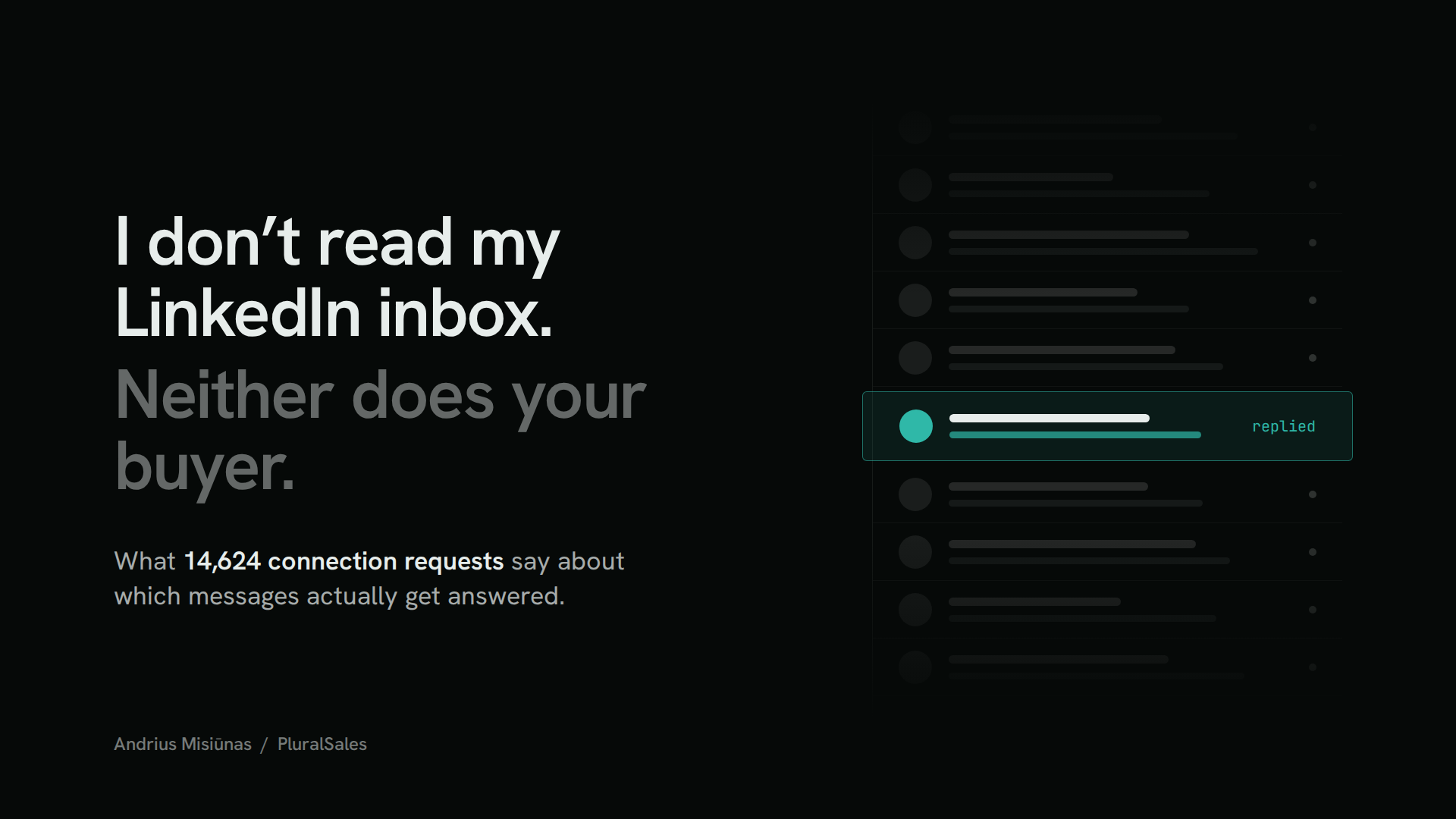
I don't read my LinkedIn inbox. Not properly. It fills up with agency offers, offshore dev teams and "quick questions" about my growth plans faster than I can open them. I read messages from people I know. The rest wait. Most of them wait forever.
I run a LinkedIn outreach agency. If I don't watch my own inbox, why would the CFO you're targeting watch hers?
That is the honest starting point. As a cold channel, LinkedIn is bad and getting worse. It is also where most of our best client conversations start. Both are true. The difference is context. And almost nobody publishes what the results should actually look like, so this post does, with 14,624 connection requests from a sample of our own campaigns.
Why LinkedIn is a bad outreach channel
Every decision maker's inbox is a pitch pile. Tools made sending almost free, so every agency, SDR team and AI startup now sends the same message to the same people. Volume went up. The value of a single message went to zero.
Executives triage by name. If they don't recognise the sender, the message is sorted as noise before the second line. "I see you're Head of IT at Company X" is not personalisation. It is their job title read back to them.
The platform pushes back on volume too: weekly invitation limits, restricted accounts, and your message landing next to ten others that open the same way.
When it doesn't work
Most failed campaigns fail for one of five reasons.
There is no reason to talk now. A stranger with a generic insight gives the prospect nothing to place them by. No shared event, no shared community, no reason this week rather than next year.
The list was built from filters, not research. On a recent Miami fintech list, 2,574 Sales Navigator contacts came down to 95 real fits after our AI qualification agent checked every company against the ICP. That is 3.7%. The rest were dev shops that "do fintech", companies ten times too big, or people who had moved city. Send to the raw list and 96% of your messages go to the wrong people.
The first message is a pitch. Asking for 30 minutes from someone who doesn't know you exist is asking to be ignored.
The sender doesn't look real. Prospects check the profile before they reply. An empty profile with no posts makes the message look like what it probably is.
Nobody watches the replies. This is the other side of the inbox problem. A campaign runs, a prospect replies on Tuesday, someone notices on Friday. The moment is gone. Most outreach setups manage the sending, and nobody owns the conversation. That is where campaigns quietly leak.
How it has to work
Start from a real-world reason. An event they are going to. A conference where someone from their team is speaking. A community you both belong to. Not "congrats on the new role". Everyone uses that signal, and prospects know it. Real context is the only thing that gets a message out of the pile. It is why so much of our work is built around event meetings.
Be recognisable before you ask. A profile that looks alive, posts people have seen in their feed, comments under the right people's posts. When a message arrives from someone they have already seen, it gets opened. Same-market recognition is the biggest acceptance-rate multiplier we see, and it is why executive LinkedIn communication and outreach work best together.
Research is the work, not the warm-up. Every contact checked. Fewer people, the right people.
Keep a human pace. 10 to 20 new conversations a week per sender. One question per message. Never repeat a question that went unanswered.
Treat the inbox as the product. Replies answered within hours, in the sender's voice, with a clear next step.
Move offline fast. LinkedIn starts the conversation. A call, a coffee or a meeting at the event is where it goes somewhere.
What good results actually look like
Ask ten agencies what a good LinkedIn campaign looks like and you get ten different numbers, or none. So I pulled a cross-section of campaigns we ran between July 2025 and September 2026 out of our outreach platform: 14,624 connection requests across the Nordics, the Baltics, the UK and the US. It is not every campaign we ran. It is a sample that covers the full range, from warm event outreach to fully cold. Client names stay out. The contexts stay in.
| Context | Market | Invites | Accepted | Replied, of accepted | Replied, of invited |
|---|---|---|---|---|---|
| Leads from an event networking app, days before the event | Nordics | 63 | 65% | 46% | 30% |
| Executives invited to an event the market already knows | Lithuania | 410 | 64% | 51% | 33% |
| Startup conference community | Nordics and Europe | 3,715 | 46% | 31% | 14% |
| Regional business chamber event | Lithuania | 333 | 44% | 34% | 15% |
| HR conference | Lithuania | 809 | 40% | 40% | 16% |
| Tech week in the prospect's own city | UK | 389 | 38% | 25% | 10% |
| Upcoming local tech festival | Denmark | 667 | 34% | 29% | 10% |
| Large-company executives and investors, event invite with a specific angle | US | 608 | 26% | 37% | 10% |
| Same audience, same event, no angle | US | 738 | 23% | 29% | 7% |
| Same event as row two, neighbouring market | Latvia | 408 | 20% | 44% | 9% |
| Global technical niche, no event | Global | 2,933 | 16% | 24% | 3.8% |
| Cold, AI-personalised first message | UK | 1,139 | 18% | 14% | 2.5% |
| Cold, standard first message | UK | 879 | 10% | 15% | 1.5% |
| Conference attendee list, contacted after the event | Europe | 614 | 11% | 8% | 0.8% |
| All campaigns in this sample | 14,624 | 29% | 31% | 9% |
Four things stand out.
Context beats personalisation. AI-written first lines nearly doubled acceptance on a cold UK list, from 10% to 18%. Replies barely moved: 2.5% of everyone invited, against 1.5% for the standard message. Personalisation got people to click accept. It didn't give them a reason to talk. Every campaign in this sample with a real, current event or community behind it landed between 7% and 33%.
Recognition is the multiplier. Same event, same month, same approach. In Lithuania, where the event is a household name, 64% accepted. In Latvia, 20%. What changed was whether the prospect recognised what we were talking about.
An angle pays. On a US audience of large-company executives and investors we split the list: same event, same audience, one version with a specific angle, one without. The angle lifted acceptance from 23% to 26% and replies from 7% to 10% of everyone invited. Roughly 40% more conversations from the same list.
Event context expires. Community context doesn't. An attendee list contacted after the conference was over got 11% acceptance and fewer than 1% replies. A startup conference community held 43–56% acceptance for seven straight months from the event onwards, because people still identify with it. A trade show is a date. A community is an identity.
What is a good LinkedIn acceptance and reply rate?
Everyone quotes reply rate, but against different denominators. Reply rate on accepted connections flatters every campaign. Reply rate on everyone invited is the honest number. Ask which one you are being shown.
Connection acceptance. 20% is the red line. Every campaign in this sample without real context landed between 10% and 18%. Target 25–30% for well-researched outreach, and 30% and above with proximity: a shared event, a known brand, the same market. If you are under 20% at the end of week two, stop and change the list or the angle before you burn it.
Reply rate on accepted connections. 15% is the floor, and it is exactly where cold campaigns land. Target 20–25%. With real context we see 25–50%.
Reply rate on everyone invited. Cold outreach sits at 1–4%. Context gets you to 7–16%. Proximity gets you to 30%.
Replied to meeting. 10% is the floor, 15–20% the target. Below 10%, the channel is fine and the conversation handling is the problem.
The inbox. Every reply answered within 24 hours. Zero unanswered. A reply that waits three days is a lead you paid for and threw away.
Meetings. For one campaign, 2–4 qualified meetings a month plus a warm pipeline is a good month.
For comparison: InMails to US executives and investors who had never heard of the sender got a 6.6% reply rate. A recent Dutch B2B email sequence got 8.9% across all steps, 2.8% positive. LinkedIn done like email performs like email. Context is what changes the result.
What we don't count: likes, impressions, invitations sent. Conversations and meetings with named accounts are the only numbers that matter.
How we measured
The data comes from four outreach workspaces we run, covering our own campaigns and client campaigns. Client names are withheld. Each row is one campaign or one clearly separated audience within a campaign.
Accepted means the connection request was accepted. Replied means the prospect sent at least one message back after connecting, including a polite no. Each sender and prospect pair counts once. InMails and messages to people who were already connected are left out of the table and reported separately.
Rates are rounded to whole numbers, or one decimal below 5%. Campaigns that are still running will move a few points as late invitations are accepted.
Questions we get asked
What is a good LinkedIn connection acceptance rate?
Below 20% is a red line: change the list or the angle before sending more. 25–30% is a good target for well-researched outreach, and 30% or more is realistic when there is proximity, such as a shared event, a known brand or the same market. In our sample of 14,624 requests, cold campaigns landed at 10–18% and campaigns with real context at 20–65%.
What is a good LinkedIn outreach reply rate?
It depends on the denominator. Measured on accepted connections, 15% is the floor and 20–25% is a good target; with real context we see 25–50%. Measured on everyone invited, cold outreach gets 1–4%, context-based outreach 7–16%, and proximity around 30%. Across our sample, 31% of accepted connections and 9% of everyone invited replied.
Does AI personalisation improve LinkedIn outreach results?
Only a little. On a cold UK list, AI-written first lines lifted acceptance from 10% to 18%, but replies only from 1.5% to 2.5% of everyone invited. Campaigns built around a real event or community reached 7–33%. Context moves results far more than personalisation.
How many meetings should a LinkedIn outreach campaign book?
For one campaign, 2–4 qualified meetings a month plus a warm pipeline is a good month. At least 10% of replies should turn into meetings, and 15–20% is a good target. Below 10%, the problem is usually conversation handling, not the channel.
Are LinkedIn InMails better than connection requests?
Not for cold audiences. InMails to US executives and investors who had never heard of the sender got a 6.6% reply rate. Connection requests with a real event or community behind them got 7–33% of everyone invited to reply.
Back to the inbox
The people you want to reach don't read their LinkedIn inbox either. They read messages from people they recognise, about things happening in their world. Build that and LinkedIn is the best B2B channel there is. Skip it and you are one more unread message.
If you want to know where your current campaign sits against these numbers, send it to us for a diagnostic.
Andrius Misiūnas is the founder of PluralSales, a Vilnius-based agency running context-based LinkedIn outreach and executive communication for B2B companies across Europe and the US.

Andrius Misiūnas - Founder, PluralSales
I build LinkedIn-first sales systems and test everything on my own companies first.
View my LinkedIn